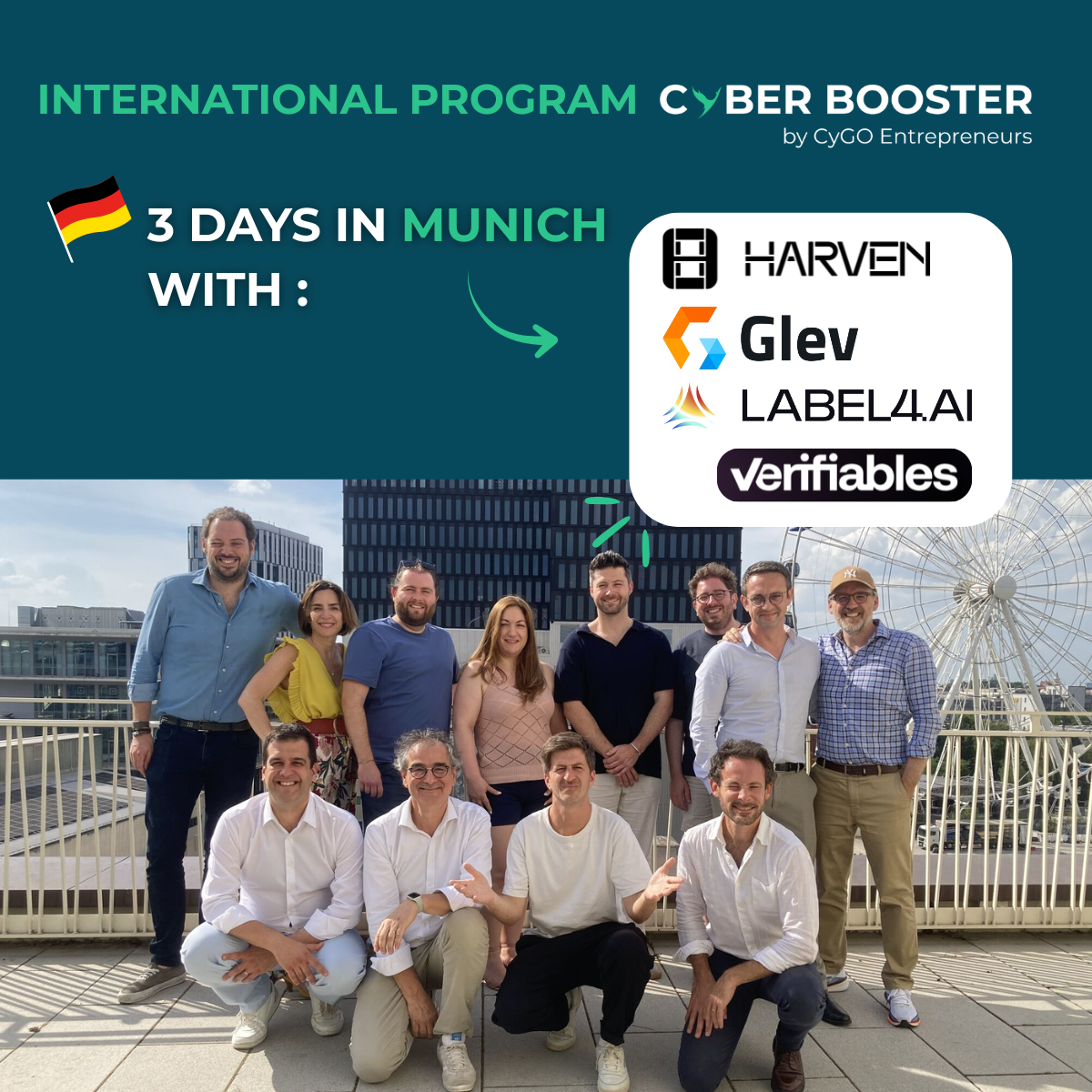
We weren’t expected. But we were welcomed.

That may be the biggest lesson we bring back from Munich.When we started designing the first Cyber Booster International Program, supported by France 2030 and delivered with Institut Mines-Télécom, our objective wasn’t to organise another international mission.It was to answer a simple question.How do you help an early-stage cybersecurity startup understand a new market?

Three days in Munich confirmed one thing.Internationalisation has very little to do with travelling.It has everything to do with preparation, relationships and what happens once you come home.

Lesson 1 — Internationalisation starts before boarding the plane.The programme actually began weeks before Munich.During a two-day bootcamp, the startups worked with Gilles Rabin, Markus Hempel, Andrea Vaugan, Dominique Lanfranchi.Not on logistics.On hypotheses.Who should they meet?Why?What did they want to learn?Which assumptions did they want to challenge?Because the objective was never to collect business cards.It was to come back with better questions than the ones they had before leaving.

Lesson 2 — Markets are built by people.Munich is home to outstanding organisations.WERK1.TUM Venture Labs.InsurTech Hub Munich.Cyberagentur.Myra Security.ComCode.Capgemini Germany.Cyber AI Expo.

But what impressed us most wasn’t the quality of the organisations.It was the people behind them.Almost none of them knew Cyber Booster beforehand.Yet every discussion was open.Every introduction sincere.Every exchange generous.We weren’t expected.But we were welcomed.Perhaps that’s the best advice we could give to entrepreneurs considering international expansion:Don’t wait until people know you.Create the opportunity to meet them.

Lesson 3 — Ecosystems reveal themselves by the way they welcome startups.One detail stayed with us.At every stage of the programme, startups were treated as participants, not visitors.They had their own booths.Their own pitch sessions.Time with founders.Time with CISOs.Time with investors.Time with communication and public affairs teams.Time to ask questions.Time to build relationships.That changes everything.

Lesson 4 — The trip is only half of the programme.Returning to France is not the end.It is where the real work starts.Every startup now enters an individual follow-up phase with the Cyber Booster team.Debriefing each meeting.Prioritising opportunities.Reworking assumptions.Structuring follow-up actions.Strengthening its international strategy.A conversation creates value only if someone helps transform it into action.This is probably the least visible part of the programme.It is also the most important.

Lesson 5 — Munich is only the beginning.One objective of this first edition was to build relationships.The next objective is to maintain them.We’ll return to Munich.We’ll deepen the partnerships initiated during these three days.We’ll bring more founders.We’ll continue connecting French and German ecosystems.And we’ll expand this approach to other European innovation hubs.Because European cybersecurity champions won’t emerge by growing in isolation.They will emerge because Europe learns to work as one ecosystem.

Thank you. This programme exists because many people chose to contribute. #France 2030. Institut Mines-Télécom. Our speakers and mentors. Our partners. The organisations that welcomed us. Everyone who made an introduction, opened a door or simply said: « Let’s have a conversation. »

Building bridges between ecosystems is a collective effort. This first edition confirmed that it is worth it. And we’re only getting started

Leave a Reply